
HOW MANY GRAFTS DO I NEED FOR A HAIR TRANSPLANT? A COMPLETE GUIDE
One of the first questions almost every patient asks is how many grafts they will need. It is a sensible question, because the number of grafts directly shapes both your final result and the cost of your treatment. Yet it is also one of the most misunderstood parts of hair restoration. The honest answer is that there is no single number that fits everyone, but there is a clear, logical way to estimate it. This guide explains what a graft actually is, how surgeons calculate the right amount for your goals, and why a proper in-person assessment in Kusadasi or Izmir matters far more than any online calculator.
WHAT IS A GRAFT, EXACTLY
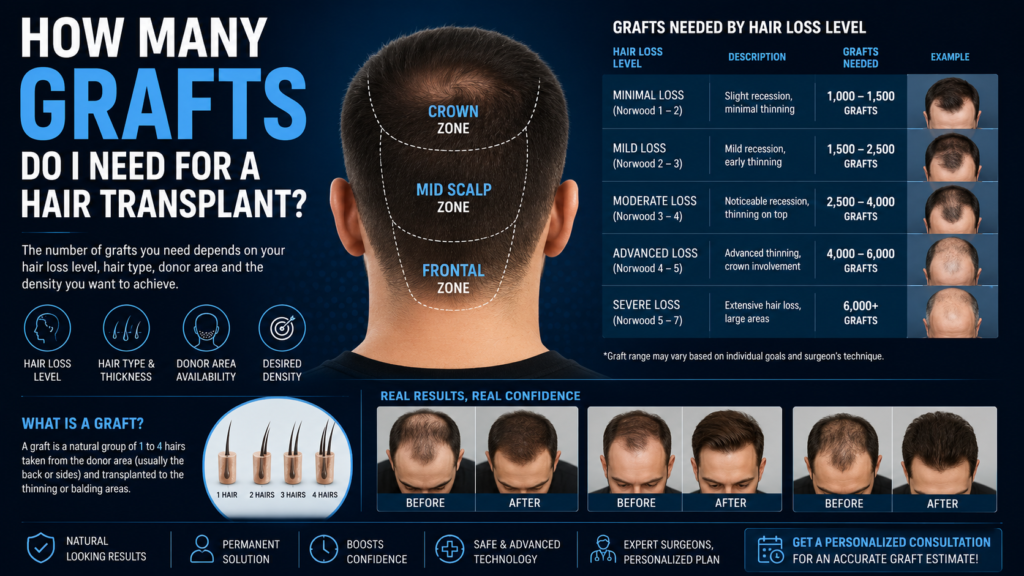
A common source of confusion is the difference between grafts and hairs. A graft is a small unit of tissue containing one or more hair follicles, and in nature these follicles grow in clusters called follicular units. Each follicular unit, and therefore each graft, can contain anywhere from one to four individual hairs. This means that two thousand grafts is not the same as two thousand hairs. Depending on the average number of hairs per graft, two thousand grafts might deliver four to five thousand actual hairs. Understanding this distinction is essential, because clinics plan and price by grafts, while the visual density you see comes from the total number of hairs those grafts contain.
WHY GRAFT NUMBERS MATTER SO MUCH
The graft count affects three things at once. First, it determines coverage, meaning how much of the thinning or bald area can realistically be filled. Second, it influences density, which is how full the result looks rather than just how wide an area has been treated. Third, it drives the price, since most reputable clinics charge per graft or build their packages around a graft range. Getting the estimate right is therefore not only about appearance but also about planning your budget and your expectations honestly before you commit to travelling for treatment.
THE NORWOOD SCALE FOR MEN
To estimate graft requirements for male pattern hair loss, surgeons use the Norwood scale, a widely recognised system that classifies balding into stages from mild to advanced. In the earliest stages, hair loss is limited to slight recession at the temples. As the stages progress, the hairline retreats further back, the crown begins to thin, and eventually the bald areas at the front and the crown can merge into one larger region. Identifying your Norwood stage gives a reliable starting point for estimating how many grafts a natural result will require, and it is almost always one of the first things a surgeon will assess during your consultation.
TYPICAL GRAFT RANGES BY STAGE
While every patient is different, some general ranges help set expectations. Early recession affecting just the temples or a slightly receding hairline might need somewhere in the region of one thousand five hundred to two thousand grafts. More noticeable loss across the frontal area with a deeper receding hairline often calls for around two thousand to three thousand grafts. When thinning extends into the mid-scalp and the crown begins to show through, the requirement can rise to roughly three thousand to four thousand five hundred grafts. Advanced loss covering large areas of the front, mid-scalp, and crown can require well over four thousand grafts, and in such cases the work is sometimes divided across more than one session to protect the donor area. These figures are guidelines only, and your true number depends on your individual pattern and your personal goals.
WHAT ABOUT WOMEN
Female hair loss tends to follow a different pattern, usually showing as diffuse thinning across the top of the scalp rather than a receding hairline, and it is assessed using the Ludwig scale. Because women generally keep their frontal hairline, treatment often focuses on adding density to thinning areas rather than rebuilding a whole hairline from scratch. Graft numbers vary widely depending on the extent of the thinning, and a careful assessment is especially important here, since the underlying causes of hair loss in women can be more varied and sometimes need medical investigation before any surgical procedure is considered or recommended.
DIFFERENT AREAS NEED DIFFERENT AMOUNTS
The region being treated has a big influence on the graft count. The hairline and frontal third are high-impact areas that frame the face, so they are often prioritised and may need carefully angled grafts to look natural and undetectable. The crown, on the other hand, is a curved, swirling area that can absorb a surprisingly large number of grafts to achieve good density, because of the way hair radiates outward from a central point. The temples and mid-scalp each have their own requirements too. A skilled surgeon plans the distribution across all of these zones rather than simply spreading grafts evenly, concentrating them where they will create the greatest visual impact for the hair available.
THE ROLE OF DONOR AREA CAPACITY
An important point that many patients overlook is that grafts are not unlimited. They are harvested from the donor area, usually the back and sides of the scalp, where hair is genetically resistant to balding. Each person has a finite lifetime supply of donor grafts, and a responsible surgeon will never overharvest, because doing so can permanently thin the donor region and leave it looking patchy or sparse. This is why careful planning matters so much, particularly for younger patients or those with advanced loss. Sometimes the realistic graft count is limited not by the size of the bald area, but by how much healthy donor hair is safely available.
FACTORS THAT CHANGE YOUR PERSONAL NUMBER
Beyond the area and stage of loss, several individual characteristics affect how many grafts you need to achieve a satisfying result. Thick, coarse hair provides more visual coverage per graft than fine hair, so a person with coarse hair may need fewer grafts for the same apparent density. The contrast between your hair colour and your skin tone also plays a role, since low contrast tends to look fuller and hides the scalp more effectively. Wavy or curly hair can give the impression of greater density as well, because it covers more surface area. Your personal goals matter too, as someone wanting maximum density will naturally need more grafts than someone happy with lighter, natural-looking coverage.
WHY ONLINE CALCULATORS ARE ONLY A STARTING POINT
Many websites offer graft calculators, and while they can give a rough idea, they cannot replace a trained and experienced eye. A calculator cannot feel the laxity of your scalp, measure your donor density under magnification, assess your hair calibre, or fully understand the subtle goals you have for your new hairline. The most accurate estimates come from a proper consultation, where clear photographs and an in-person or detailed online assessment allow the surgeon to evaluate all of these factors together. Treat any number you generate online as a ballpark figure to discuss with a professional, not as a final and fixed treatment plan.
ONE SESSION OR SEVERAL
For most patients, the required grafts can be transplanted in a single session, particularly with modern techniques that allow large numbers of grafts to be placed in one day. However, when the area is very large or the desired density is high, dividing the work across two sessions can produce a better and safer result while also protecting the donor area from overharvesting. Splitting the treatment also allows the first set of grafts to mature before further work is planned. Your surgeon will advise whether a single session is realistic for your case or whether a staged approach will serve you better over the long term.
HOW GRAFT COUNT AFFECTS COST

Because pricing is usually linked directly to the number of grafts, your estimated graft count is the key to understanding your likely overall cost. This is one of the reasons Kusadasi and the wider Izmir region have become so attractive to international patients, as the price per graft is generally far more competitive than in the United Kingdom and much of Europe, while the clinics use the same modern techniques and internationally recognised standards. When comparing different quotes, always check whether the price is based on grafts and exactly what is included, so that you are comparing like for like rather than being drawn in by a low headline figure.
GETTING AN ACCURATE ASSESSMENT IN KUSADASI
The best way to know your true graft requirement is a thorough consultation with an experienced team. Many clinics offer a free online evaluation, where you send clear photographs of your hairline, crown, and donor area, and then receive an informed estimate together with a suggested plan. This can later be confirmed in person before your procedure begins. Having your assessment and treatment on the beautiful Aegean coast also means you can combine genuinely expert care with a comfortable recovery in a stunning setting, turning a practical medical trip into a far more pleasant experience.
FINAL THOUGHTS
There is no universal answer to how many grafts you need, because the right number depends on your pattern of loss, your hair characteristics, your donor supply, and your personal goals. What matters most is a realistic, well-planned approach that protects your donor area while delivering natural density where it counts most. Rather than fixating on a single figure, focus on finding an experienced team who will assess you honestly and design a plan around your individual needs. With the right guidance, your graft count stops being a guess and becomes a clear, confident roadmap to a natural-looking, lasting result.