
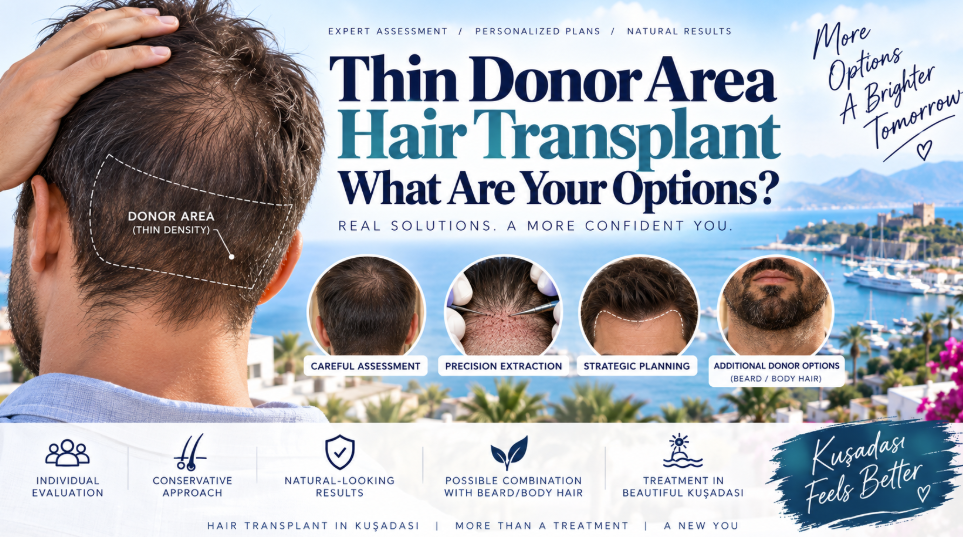
Thin Donor Area Hair Transplant – What Are Your Options?
A thin donor area is one of the most important challenges to consider before a hair transplant. If the hair at the back and sides of your scalp is naturally fine, has low density, shows signs of miniaturisation, or has already been heavily used during a previous procedure, you may wonder whether a hair transplant is still possible.
The answer depends on much more than the amount of hair loss visible on the top of the scalp.
A hair transplant with a thin donor area may still be possible for selected patients, but treatment usually requires a more conservative and strategic approach. Instead of trying to extract the maximum possible number of grafts, the priority should be to protect the remaining donor hair and use the available follicles where they can provide the greatest cosmetic benefit.
For some patients, this may mean concentrating grafts in the frontal area rather than attempting full scalp coverage. For others, beard hair may provide an additional donor source. In more advanced cases, combining scalp, beard and selected body hair may be considered. There are also situations in which further transplantation is not advisable.
This complete guide explains the options for patients with a thin or weak donor area, including FUE, DHI, beard and body hair transplantation, conservative hairline design, crown planning, second hair transplants and donor-area preservation.
What Is the Donor Area in Hair Transplantation?
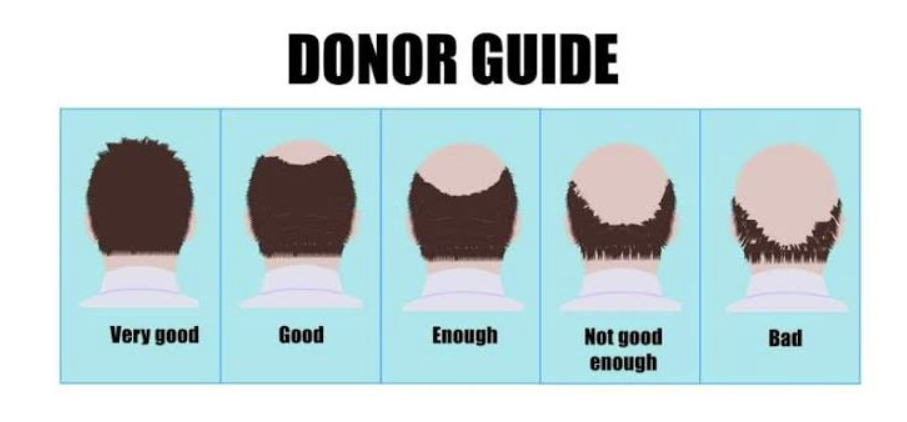
The donor area is the region from which follicles are obtained for transplantation.
For most patients, the primary donor zone is located at the back and sides of the scalp. Follicular units are extracted from this area and relocated to areas affected by hair loss.
The donor supply is finite.
Hair transplantation does not create new follicles. It redistributes existing ones.
This is why a patient with extensive baldness but a limited donor area cannot simply continue having unlimited grafts transplanted until the entire scalp has its original density.
A responsible treatment plan must balance two objectives: improving the recipient area while maintaining an acceptable appearance in the donor area.
What Does a Thin Donor Area Mean?
A thin donor area does not mean exactly the same thing for every patient.
Some people naturally have relatively low hair density at the back and sides of the scalp. Others have a reasonable number of follicles but very fine hair shafts, which can make the donor area appear less dense.
Other possible reasons include:
- Diffuse thinning
- Follicular miniaturisation
- Previous FUE procedures
- Previous FUT surgery
- Donor-area scarring
- Age-related changes
- Naturally fine hair
- Poorly distributed previous extractions
- Donor overharvesting
The cause matters because different donor problems require different treatment strategies.
Can You Have a Hair Transplant With a Thin Donor Area?
Potentially, yes.
A thin donor area does not automatically exclude someone from hair transplantation.
However, suitability depends on the degree and cause of donor thinning, the size of the recipient area, hair characteristics, previous procedures and the patient’s expectations.
For example, someone with mild frontal recession and a relatively thin but stable donor area may require a modest number of grafts.
Another patient may have extensive frontal, mid-scalp and crown baldness combined with poor donor density.
These are very different situations.
In the second case, attempting to cover the entire scalp at high density may simply not be realistic.
The treatment strategy may instead need to prioritise selected areas.
Option 1: Use Fewer Scalp Grafts Strategically
One of the most important options for a thin donor area is also one of the simplest:
Do not extract more grafts than the donor area can reasonably provide.
Patients sometimes believe that 4,000 or 5,000 grafts must automatically produce a better result than 2,000 or 2,500 grafts.
That is not necessarily true.
If a donor area cannot safely support a large extraction, pursuing a high graft number can create visible thinning at the back and sides of the scalp.
A smaller procedure with intelligent graft distribution may produce a better overall cosmetic balance.
The objective is not the highest graft count.
It is the best realistic use of the available donor supply.
Option 2: Prioritise the Frontal Area
Patients with extensive hair loss and limited donor capacity may need to decide which areas matter most.
The frontal region is often particularly important because it frames the face.
A carefully designed hairline with useful density behind it can produce a substantial visual change when the patient is viewed from the front.
Trying to distribute a limited number of grafts equally across the hairline, mid-scalp and crown may result in low density everywhere.
In selected cases, concentrating available grafts in the frontal third can create a stronger cosmetic effect.
This does not mean every patient should ignore the crown. It means graft allocation should reflect donor capacity and individual priorities.
Option 3: Choose a Conservative Hairline
Hairline position has a direct relationship with graft requirements.
A very low hairline creates a larger recipient area.
A larger recipient area requires more grafts to achieve comparable visual density.
For patients with a thin donor area, aggressively lowering the hairline may therefore consume valuable follicles unnecessarily.
A slightly higher, age-appropriate hairline can reduce the surface area requiring transplantation and preserve grafts for the mid-scalp or possible future procedures.
This is why natural hairline design and donor management should always be planned together.
The lowest possible hairline is not necessarily the best hairline.
Option 4: Consider Beard Hair as an Additional Donor Source
When the scalp donor area cannot provide enough follicles, beard hair may be considered as an additional donor source in selected patients.
Beard follicles can be useful because they are often relatively thick.
Their calibre can provide useful visual coverage when strategically combined with scalp grafts.
However, beard hair is not identical to scalp hair.
It can differ in:
- Thickness
- Texture
- Curl
- Growth cycle
- Maximum length
- Colour
For this reason, beard hair should not simply be treated as interchangeable with scalp hair.
When suitable scalp follicles are available, finer single-hair scalp grafts are generally particularly valuable for creating the delicate leading edge of a natural hairline.
Beard grafts may be more useful farther behind the frontal edge or in other selected areas requiring additional coverage.
Option 5: Combine Scalp and Beard Grafts
For patients with limited scalp donor capacity, combining donor sources may expand the possibilities.
Imagine that a patient has some usable scalp follicles but not enough to treat the desired area effectively.
Instead of overharvesting the scalp, a treatment plan may potentially use scalp grafts for aesthetically sensitive regions and beard grafts as supplementary follicles.
This can be particularly relevant for:
- Advanced hair loss
- Second hair transplantation
- Previous FUE patients
- Hair transplant repair
- Selected crown cases

The exact distribution needs to be individualised.
The purpose of combining donor sources is not to maximise the headline graft number. It is to use different types of follicles intelligently.
Option 6: Consider Chest or Other Body Hair
When both scalp and beard donor supplies are limited, selected patients may ask about body hair transplantation.
Chest hair is one possible secondary donor source.
However, chest hair is not a perfect substitute for scalp hair.
Its growth characteristics, calibre, texture and maximum length can differ significantly from scalp follicles.
Body hair should therefore generally be regarded as a supplementary resource for carefully selected cases rather than an unlimited source of replacement follicles.
The usefulness of chest hair varies substantially between individuals.
Some patients may have body hair with characteristics that offer limited cosmetic value for scalp transplantation.
An individual assessment is essential.
Option 7: Avoid Treating the Entire Crown
The crown can be challenging when donor capacity is limited.
Why?
Because the crown may represent a large surface area and has a natural whorl pattern that can require careful graft distribution.
A patient with frontal, mid-scalp and crown loss may therefore require a substantial total number of grafts if all regions are to be treated.
When the donor area is thin, attempting dense crown coverage can consume follicles that may be more valuable elsewhere.
Some patients may benefit from prioritising the front and mid-scalp while accepting lighter crown coverage.
Others may consider crown treatment during a later procedure if sufficient donor capacity remains.
There is no universal rule. The important point is that crown transplantation should not be planned without considering lifetime donor supply.
Option 8: Plan a Smaller FUE Procedure
FUE can be used in patients with different donor characteristics, but the extraction pattern and number of grafts must be appropriate.
During FUE, individual follicular units are removed from the donor area.
If too many follicles are extracted from a low-density donor region, the remaining hair may no longer provide sufficient visual coverage.
A smaller FUE session may therefore be more appropriate than an aggressive extraction.
The medical team should consider not only how many follicles can technically be removed but also how the donor region is likely to look afterwards.
Technical possibility and aesthetic suitability are not always the same thing.
Is DHI Better for a Thin Donor Area?
DHI is frequently marketed as an answer to many hair transplant problems, including weak donor areas.
This requires clarification.
DHI generally describes an implantation approach, often involving specialised implanter devices. It does not create additional donor follicles.
If the scalp donor area contains a limited number of suitable grafts, choosing DHI does not suddenly increase that supply.
DHI may be useful for certain recipient-area situations, but donor limitation remains a donor limitation regardless of the implantation method.
The choice between FUE-based approaches, DHI implantation or other techniques should therefore be based on individual requirements rather than the assumption that one method can overcome insufficient donor capacity.
Thin Donor Area After a Previous Hair Transplant
Previous surgery is one of the most common reasons patients have reduced donor capacity.
Suppose a patient previously underwent FUE with several thousand grafts.
Years later, natural hair loss progresses and another transplant is desired.
The second consultation should not begin by automatically promising another large session.
Instead, the donor area should be reassessed.
Important questions include:
How many grafts were previously removed?
How evenly were they extracted?
Does the donor area already look depleted?
Is there evidence of overharvesting?
How much stable donor capacity remains?
Could beard hair supplement the scalp donor supply?
These questions are essential when planning a second hair transplant with a thin donor area.
What Is an Overharvested Donor Area?
Overharvesting occurs when excessive numbers of follicles are removed or when extraction is poorly distributed.
The donor region can develop a visibly patchy or “moth-eaten” appearance.
This is particularly noticeable when the remaining hair is worn short.
Overharvesting is difficult to correct because follicles have already been removed.
This makes prevention extremely important.
Patients should be cautious about choosing a clinic simply because it advertises “maximum grafts” or very large extraction numbers.
More grafts are not always better if obtaining them damages the donor area.
Does Donor Hair Grow Back After FUE?
This question is frequently misunderstood.
When an intact follicular unit is extracted during FUE and transplanted elsewhere, that follicle does not simply regenerate in its original donor location.
The surrounding donor hair continues growing, and small extraction sites heal, which can make the area look relatively uniform when harvesting is appropriately distributed.
But the donor supply should still be treated as limited.
This is exactly why long-term planning is important.
Can PRP or Other Treatments Create More Donor Grafts?
Patients with thin donor areas sometimes look for treatments that will allow thousands of additional grafts to be extracted.
This should be approached realistically.
PRP and other non-surgical treatments may be discussed for specific indications, but they should not be presented as methods that create an unlimited new supply of donor follicles.
If the donor region is genuinely low-density or has already been heavily harvested, treatment planning must respect that limitation.
The same principle applies to cosmetic products claiming to transform an inadequate donor area into a strong one.
Thin Hair vs Thin Donor Area
These terms should not be confused.
A patient may have a reasonable number of follicles but naturally fine hair shafts.
Another patient may have thick individual hairs but relatively low follicular density.
These situations can look similar at first glance but have different implications.
Hair calibre influences visual coverage.
Thicker or curlier hair can sometimes create a stronger impression of density than very fine, straight hair.
Hair-to-scalp colour contrast also affects the visual result.
Therefore, donor assessment should consider more than the number of visible hairs.
Thin Donor Area and Advanced Norwood Hair Loss
Patients with Norwood 6 or 7 hair loss require especially careful planning.
The recipient area can be extremely large, while the permanent donor supply remains limited.
It may simply be impossible to recreate the patient’s original density across the entire scalp.
This does not necessarily mean no improvement can be achieved.
A conservative hairline, strategic frontal coverage and selective use of additional donor sources may create meaningful change in suitable patients.
But realistic expectations are essential.
The goal should be improvement—not a promise to reverse every aspect of advanced baldness.
Can a Thin Donor Area Be Made to Look Thicker?
The answer depends on why it appears thin.
If the donor region contains miniaturised hairs, the underlying cause may require medical evaluation.
If it appears thin because of previous overharvesting, options become more limited.
Selected patients may discuss scalp micropigmentation or, in some circumstances, transplantation into depleted donor areas using follicles obtained from another source.
However, repair can be complex.
The best strategy remains preventing unnecessary donor depletion during the original procedure.
How Is a Thin Donor Area Assessed?
A proper assessment considers the complete scalp rather than only the bald recipient area.
The medical team may evaluate:
- Donor density
- Hair calibre
- Miniaturisation
- Follicular-unit characteristics
- Hair texture
- Previous extraction patterns
- Scarring
- Recipient-area size
- Current hair-loss pattern
- Potential future hair loss
Patients with previous hair transplantation should provide details of earlier procedures whenever possible.
Approximate graft numbers, dates and techniques can help with planning.
Photo Assessment Before a Hair Transplant in Kusadasi
International patients considering a hair transplant in Kusadasi, Turkey can usually begin with a preliminary photographic assessment.
Useful photographs include:
- Front hairline
- Front with hair pulled back
- Top of scalp
- Crown
- Left side
- Right side
- Back donor area
- Both donor sides
Photos should be clear and taken in good lighting without hair fibres or concealing products.
If beard donor hair is being considered, photographs from the front, both sides and beneath the jawline can also be useful.
Photos can help with preliminary planning, but final suitability and graft strategy should be confirmed through appropriate clinical assessment.
Hair Transplant in Kusadasi With a Thin Donor Area
For patients considering a hair transplant in Kusadasi, having a thin donor area does not mean the consultation should focus on finding a clinic willing to promise the largest graft number.
It should focus on finding the most sustainable strategy.
That could mean using fewer scalp grafts, maintaining a slightly more conservative hairline, prioritising the frontal region, leaving the crown lighter or incorporating beard hair in suitable patients.
For international patients combining treatment with a Kuşadası holiday, postoperative planning also matters. Swimming, beach activities, strong sun exposure and strenuous exercise may need to be restricted temporarily according to the medical team’s instructions.
The treatment should therefore be planned first, with the holiday organised around the recovery period.
Thin Donor Area Hair Transplant – Final Thoughts
A thin donor area does not automatically mean that you cannot have a hair transplant. It does mean that the procedure requires more careful planning.
The most important principle is simple:
Your donor hair is a limited resource.
The objective should not be to extract as many grafts as possible during one procedure. The objective should be to achieve the greatest realistic cosmetic improvement while protecting the remaining donor area.
Depending on the individual case, the options may include a smaller FUE procedure, conservative hairline design, prioritising the frontal scalp, reducing crown coverage, combining scalp and beard grafts, or considering selected body-hair follicles.
For some patients, however, the available donor supply may simply be insufficient for the requested result. In that situation, reducing the treatment area—or deciding against further transplantation—can be the more responsible recommendation.
Before planning a hair transplant in Kusadasi with a thin or weak donor area, both the recipient and donor regions should be evaluated carefully. Patients who have undergone previous procedures should also have their remaining donor capacity assessed before another extraction is planned.
A successful hair transplant is not defined by the largest graft number.
It is defined by intelligent donor management, natural distribution, realistic expectations and a treatment plan designed for the long term.