
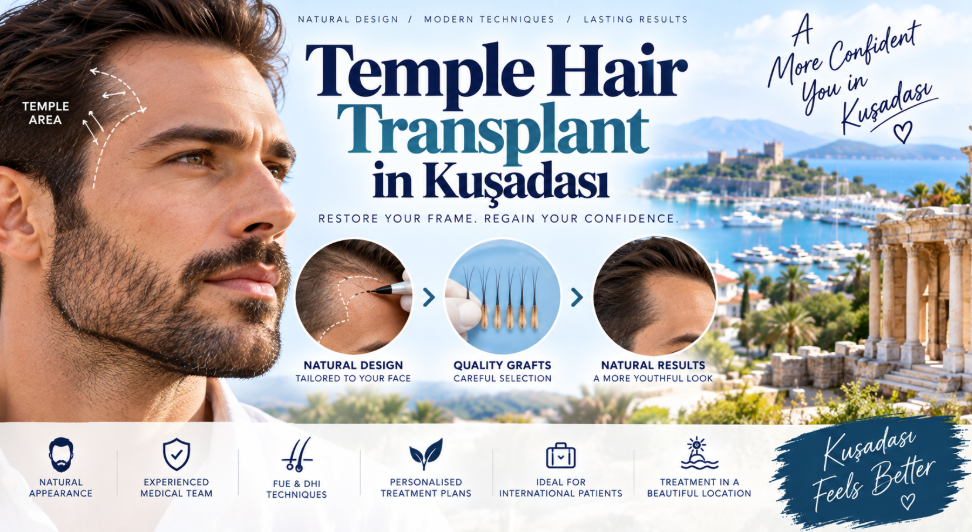
Temple Hair Transplant in Kusadasi – Complete Guide to Natural Temple Restoration
Temple recession can dramatically change the appearance of the face. Even when there is still good hair density on the top of the scalp, thinning around the temples can make the hairline appear higher, wider and more mature. For suitable patients, a temple hair transplant in Kusadasi can restore selected areas of recession and create a more balanced transition between the frontal hairline and the sides of the face.
However, temple restoration is not simply a matter of filling two empty areas with grafts.
The temples are among the most technically sensitive areas in hair transplantation. Natural temple hairs usually grow at very specific angles, directions and densities. The hairs close to the edge can also be finer than those farther back on the scalp. If these details are ignored, even good graft growth can produce an unnatural appearance.
For this reason, successful temple hair restoration requires careful hairline design, appropriate graft selection, precise implantation and realistic long-term planning.
This complete guide explains how a temple hair transplant works, who may be suitable, how many grafts may be needed, FUE and DHI options, temple-point design, donor-area considerations, recovery and what international patients should know when considering a hair transplant in Kusadasi, Turkey.
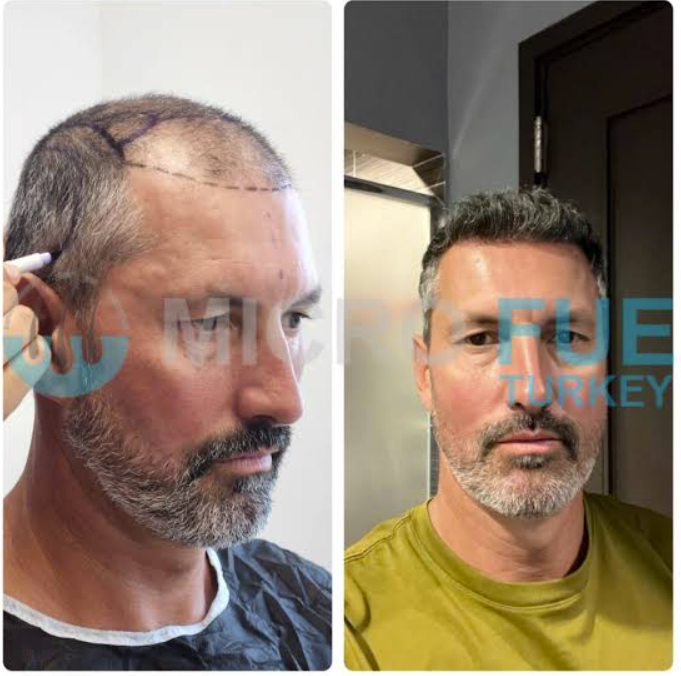
What Is a Temple Hair Transplant?
A temple hair transplant is a hair restoration procedure designed to place suitable donor follicles into areas of hair loss or recession around the temporal regions.
The temples are located on either side of the frontal hairline.
Some people naturally have relatively open temples. Others gradually develop recession because of androgenetic hair loss.
The pattern can range from mild triangular recession to substantial loss extending farther into the frontal scalp.
During transplantation, suitable follicles are normally extracted from the donor region at the back and sides of the scalp and carefully placed into the planned temple areas.
The objective is not necessarily to recreate the patient’s teenage hairline.
Instead, treatment should aim to produce a natural, proportionate and sustainable design.
Why Do the Temples Recede?
One of the most common causes of temple recession in men is androgenetic alopecia, commonly known as male pattern hair loss.
The process often begins around the frontotemporal corners.
Over time, the hairline may develop an increasingly pronounced M-shaped pattern. In some men, recession progresses farther back while thinning also develops through the frontal scalp, mid-scalp or crown.
However, not every mature-looking temple requires transplantation.
Some people naturally develop a slightly higher adult hairline without progressing rapidly toward advanced baldness.
This distinction is particularly important in younger patients.
A hair transplant should therefore not be planned based solely on a photograph of the temples. Age, family history, current pattern, stability of hair loss and donor characteristics should also be considered.
Who May Be Suitable for Temple Hair Restoration?
Potential candidates include patients with stable temple recession and an appropriate donor area.
Temple transplantation may be considered for people with:
- Receding temples
- An M-shaped hairline
- Uneven temple recession
- Previous hairline transplantation requiring refinement
- Localised hair loss around the temples
- A naturally high or wide frontal hairline in selected cases
The degree of recession does not determine suitability by itself.
Donor density, hair calibre, future hair-loss risk and the amount of existing hair around the recipient area are also important.
Patients with active or unexplained hair loss may require further assessment before surgery is considered.
Temple Hair Transplant for an M-Shaped Hairline
The classic M-shaped hairline develops when both temporal corners recede while the central frontal region remains farther forward.
For some patients, this can make the forehead appear larger even when substantial hair remains elsewhere.
A temple hair transplant for an M-shaped hairline can potentially fill selected areas of recession and create a smoother transition between the central hairline and lateral regions.
However, simply connecting two points with a straight line is not enough.
The shape should complement the patient’s face, age and existing frontal hair.
An overly aggressive design can look unnatural, particularly if the patient later develops additional hair loss behind the transplanted region.
Why Temple Hair Transplantation Is Technically Challenging
The temple region has distinctive hair-growth characteristics.
Natural hairs around the temples often emerge at relatively acute angles and follow directional patterns that differ from the central frontal scalp.
These characteristics need to be reproduced during transplantation.
If grafts are placed too vertically, the hairs may stick outward rather than lying naturally against the scalp.
If the direction changes abruptly, the transplanted region may not blend with existing hair.
Density is another consideration.
The aim is not simply to pack the maximum possible number of grafts into the temples. Appropriate spacing and gradual transitions are essential to a natural appearance.
Natural Temple Hairline Design
Design is one of the most important stages of a temple hair transplant in Kusadasi.
The medical team needs to consider the relationship between:
- Central frontal hairline
- Frontotemporal corners
- Temple points
- Forehead width
- Facial proportions
- Existing hair direction
- Patient age
- Future hair loss
- Donor capacity
Natural temple areas are not perfectly symmetrical geometric shapes.
Small differences between the two sides of the face are common.
The objective should therefore be facial balance rather than mathematical perfection.
What Are Temple Points?
Temple points are the lateral areas of hair that help frame the face between the frontal hairline and sideburn region.
When temple points recede substantially, the forehead and upper face can appear wider.
Restoring them can potentially improve facial framing in selected patients.
However, temple-point reconstruction is particularly demanding.
The natural hairs in this region may be fine and grow at extremely acute angles. Thick, coarse grafts implanted in the wrong direction can create an obvious transplanted appearance.
Not every patient with frontal recession needs full temple-point reconstruction.
Sometimes restoring the frontotemporal corners without aggressively rebuilding the lateral temple points provides a more natural and age-appropriate result.
Why Single-Hair Grafts Matter
Follicular units can contain one, two, three or sometimes more hairs.
For delicate areas around the hairline and temples, carefully selected single-hair follicular units can be especially important.
Using coarse multi-hair grafts directly along the edge may create a harsh transition.
Single-hair grafts can help establish a softer leading zone, while suitable multi-hair follicular units may be used farther behind where greater visual density is needed.
Hair calibre also matters.
A very thick single hair can still appear different from naturally fine temple hair, so graft selection involves more than simply counting how many hairs are contained in each unit.
How Many Grafts Are Needed for a Temple Hair Transplant?
There is no standard graft number for temple restoration.
A small area of mild recession requires a very different plan from substantial bilateral temple loss combined with frontal hairline reconstruction.
The graft requirement depends on:
- Size of both temple areas
- Existing hair density
- Desired hairline position
- Whether temple points are included
- Hair calibre
- Hair texture
- Donor capacity
- Degree of frontal recession
- Desired visual density
For this reason, online statements claiming that every temple transplant requires a specific number of grafts can be misleading.
The graft estimate should follow individual assessment.

Can the Temples and Hairline Be Transplanted Together?
Yes, in suitable patients the frontal hairline and temples can be planned as one treatment area.
In fact, treating them together can sometimes create a more coherent transition.
The central hairline should flow naturally toward the frontotemporal corners rather than appearing as separate transplanted sections.
However, a larger treatment area requires more donor follicles.
For patients with limited donor capacity or advanced hair loss, the clinician needs to determine whether using additional grafts in the temples is the best long-term allocation of donor resources.
FUE Temple Hair Transplant in Kusadasi
FUE, or Follicular Unit Extraction, is commonly used for modern hair transplantation.
During FUE, individual follicular units are extracted from the donor region.
The grafts can then be examined and selected according to the treatment plan.
For temple restoration, appropriate graft selection is particularly valuable because softer follicular units may be required around the edges.
Recipient sites are planned according to the intended direction, angle and density.
FUE describes the extraction approach; it does not automatically guarantee a natural temple result.
The design and implantation strategy remain critical.
DHI Temple Hair Transplant in Kusadasi
DHI hair transplantation generally refers to an implantation approach using specialised implanter devices.
DHI may be considered for selected temple and frontal procedures, particularly when precise placement among existing hairs is required.
However, it is important not to treat DHI as automatically superior to every other approach.
Whether implantation is performed with an implanter or another appropriate technique, the essential factors remain:
design, graft quality, angle, direction, distribution and donor management.
Technique should be selected according to the patient’s individual requirements rather than marketing terminology.
Is Temple Hair Transplant Suitable for Young Men?
Young men frequently enquire about temple restoration because frontal recession can begin relatively early.
This requires particular caution.
A patient in his early twenties may want to restore the exact hairline he had as a teenager. However, his eventual pattern of androgenetic hair loss may not yet be established.
If an extremely low hairline and fully closed temples are created while natural hair behind them continues to recede, future transplantation may become necessary.
The available donor supply also needs to support those future requirements.
Age alone does not determine suitability, but younger patients benefit from especially careful long-term planning.
Mature Hairline vs Receding Hairline
Not every change around the temples represents aggressive hair loss.
Some men develop a more mature frontal shape as they move from adolescence into adulthood.
Determining whether the hairline is relatively stable or actively receding can influence treatment planning.
Photographs taken over several years can sometimes help demonstrate progression.
Family history and examination of the surrounding hair can also provide useful information.
Patients should avoid rushing into surgery solely because the adult hairline differs from their teenage appearance.
Temple Hair Transplant and Donor Area Strength
Even a relatively small temple transplant uses follicles from a limited donor supply.
For patients with strong donor characteristics and localised recession, this may not present a major limitation.
But patients with extensive hair loss or a thin donor area require greater caution.
If frontal, mid-scalp and crown restoration may eventually be needed, every graft should be considered part of a lifetime donor budget.
An aggressive temple design may use grafts that could become more valuable elsewhere later.
For this reason, donor assessment should form part of temple planning even when the recipient area appears relatively small.
Can Beard Hair Be Used for Temple Restoration?
Beard hair can sometimes serve as an additional donor source in hair transplantation, but it has different characteristics from scalp hair.
Beard follicles are often relatively coarse.
That can make them useful for adding visual coverage in selected scalp areas, particularly when scalp donor capacity is limited.
However, coarse beard hair is generally less suited to the delicate leading edge of the temples, where softer and finer follicles may be needed.
When adequate scalp donor hair is available, carefully selected scalp grafts are usually particularly valuable for natural temple-edge reconstruction.
Temple Hair Transplant for Women
Women may also seek temple restoration.
Female temple thinning can occur for several reasons, including traction-related hair loss and certain patterns of female hair loss.
Some women may also naturally have a higher or wider hairline and seek improved framing around the temples.
Female temple transplantation requires careful assessment because diffuse thinning can sometimes involve both the recipient and donor regions.
The cause of hair loss should therefore be considered before surgery.
In suitable cases, temple transplantation may be incorporated into a broader female hairline lowering or female hair transplant plan.
Temple Hair Transplant Repair
Some patients seek treatment after a previous transplant because their temple or frontal design appears unnatural.
Possible concerns include:
- Hair growing too vertically
- Overly straight borders
- Excessively low temple points
- Poor symmetry
- Low density
- Coarse grafts along the edge
- Poor blending with native hair
Hair transplant repair can be more complicated than first-time transplantation.
The existing grafts, remaining donor capacity and surrounding natural hair need to be evaluated before deciding what can realistically be improved.
In selected cases, additional fine grafts can help soften an unnatural transition.
What Happens on the Day of a Temple Hair Transplant?
The process begins with reviewing the proposed design.
The frontal hairline, temple corners and any temple-point work should be discussed and marked before transplantation.
The donor area is then prepared according to the selected extraction plan.
Local anaesthesia is typically used for the treatment areas.
Suitable follicular units are extracted, prepared and then implanted according to the planned direction and distribution.
Procedure duration varies according to the number of grafts and whether the temples are being treated alone or together with a larger frontal area.
Recovery After Temple Hair Transplantation
During the early recovery period, small crusts and temporary redness can develop around implanted grafts.
Some swelling can also occur.
Patients receive instructions explaining how to protect and wash the transplanted area.
The grafts should not be scratched or aggressively rubbed.
Because the temples are highly visible, patients sometimes worry about returning to social activities.
The appearance changes gradually as early healing progresses, but individual recovery differs.
Patients should follow their treatment team’s specific instructions rather than relying on a universal online timetable.
When Does Temple Hair Start Growing?
A temple transplant does not provide its final appearance immediately.
Transplanted hairs commonly undergo an early shedding phase.
New growth then develops gradually as follicles progress through their natural cycles.
Early new hairs may initially appear fine before maturing over subsequent months.
The overall result is usually assessed over a longer period rather than during the first few weeks.
Individual growth rates vary, and exact density or growth timing cannot be guaranteed.
Can You Swim After a Temple Hair Transplant in Kusadasi?
Kuşadası is a popular coastal destination, so this is particularly relevant for international patients.
You should not assume that you can undergo transplantation and immediately return to swimming, beach clubs or prolonged sun exposure.
The recipient and donor regions require time to heal.
Swimming pools, seawater, strong sun and strenuous activity may need to be avoided temporarily according to postoperative instructions.
If swimming is an important part of your holiday, enjoying the beach before your procedure may be more practical.
Can You Combine a Temple Hair Transplant With a Kusadasi Holiday?
Yes, with appropriate planning.
International patients can potentially combine a hair transplant in Kusadasi with a stay on Turkey’s Aegean coast.
Kuşadası is also well placed for visitors interested in Ephesus and the surrounding region.
However, sightseeing and holiday activities should be organised around the medical procedure.
Before transplantation, patients can generally enjoy their trip normally. After treatment, recovery becomes the priority.
Activities involving direct sun, swimming, heavy exercise or risk of contact with the transplanted area may need to be postponed.
Temple Hair Transplant Consultation in Kusadasi
An initial remote assessment can begin with clear photographs.
For temple restoration, useful images include:
- Straight frontal view
- Hairline with hair pulled back
- Left temple
- Right temple
- Top of scalp
- Crown
- Back donor region
- Both donor sides
The crown and donor region are important even if the patient only wants temple restoration because long-term hair-loss planning should consider the entire scalp.
Patients should also provide information about previous hair transplants, hair-loss history and relevant medical information.
Photographs can support preliminary planning, but final suitability and design should be confirmed through appropriate clinical assessment.
Temple Hair Transplant in Kusadasi – Final Thoughts
A temple hair transplant in Kusadasi can potentially restore receded frontotemporal areas and improve the way the hairline frames the face.
But natural temple restoration requires much more than filling empty skin with grafts.
The most important considerations include hairline shape, temple-point design, single-hair graft selection, implantation angle, natural direction, donor capacity and future hair-loss progression.
A good temple design should also remain believable as the patient ages.
For this reason, the lowest and most aggressive hairline is not necessarily the best option. Conservative planning can preserve valuable donor follicles while producing a more natural transition between the frontal hairline and temples.
FUE and DHI may both form part of modern temple hair restoration, depending on the individual treatment plan. Neither technique removes the need for careful design and appropriate graft selection.
For patients considering temple hair restoration in Kusadasi, Turkey, the first step should therefore be a complete assessment—not simply choosing a graft number.
The key questions are:
Is the temple recession stable? Where should the new frontotemporal corners sit? Does the donor area have sufficient capacity? How should the grafts be angled? And will the design remain natural if further hair loss occurs?
Answering these questions carefully is what turns temple transplantation from simple graft placement into a personalised, long-term hair restoration plan.